

Louvered Pergola Guide: Adjustable Roofs, Drainage and Snow
The short answer
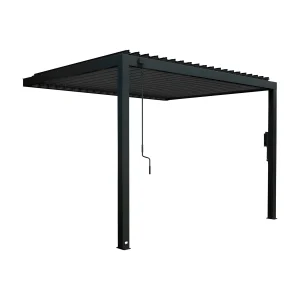
A louvered pergola has blades that turn from open to shut, so one roof gives filtered sun or cover from a shower. On the Evanston a hand wand sets the angle, rain drains out of sight through the frame and posts, and its maker rates it for 2,100 lb of snow and 100 mph winds.
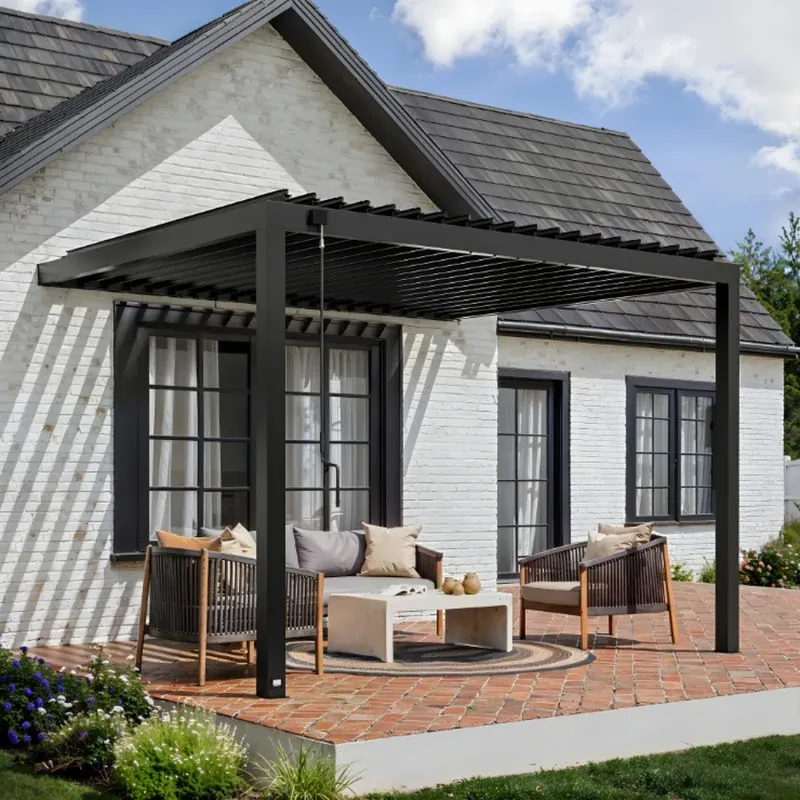
A louvered pergola replaces the fixed slats of a classic pergola with blades that turn. Angled open, they let in light and air; turned shut, they make a roof. That flexibility is the attraction, and it also brings questions an open trellis never raises: where the rain goes when the roof is closed, what snow does to it, and how the frame is fixed. This louvered pergola guide answers them using the Backyard Discovery Evanston 12×10, the louvered model in our range, as the worked example.
How the louvers turn
Louvers are long blades running across the roof, each on a pivot. Turning them together changes the roof from a series of open slots to a closed surface. On the Evanston, the blades are moved by hand with a wand, from fully open to fully shut, with any angle in between. There is no motor to wire or maintain.
The angle is the everyday control. Partly open on a hot afternoon, the blades shade the patio while letting warm air rise out. Fully open, the sky shows between them. Closed, they keep off a passing shower.
Where the rain goes
A closed louvered roof collects water across its whole area, so the drainage design matters as much as the blades. The Evanston leads rain into a concealed drainage path that runs through the frame and down the posts. That keeps water from sheeting off the edges onto people and furniture, and it means you should think about where the water exits at the foot of each post.
- Check that the ground at the post bases slopes away from the house and from seating areas.
- Keep leaves and debris out of the blade channels so water can reach the drainage path.
- On a wall-mounted model, make sure the wall side is detailed so water does not run toward the house.
Why snow ratings matter more here
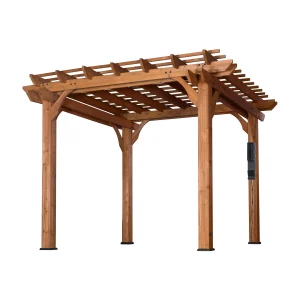
Snow does not settle on an open trellis in the same way, and our cedar trellis models list a wind figure with nothing for snow. A louvered roof closed in winter is a solid surface that holds whatever lands on it. The Evanston carries a snow rating of 2,100 lb, or 12 inches by its maker’s reckoning, and a wind rating of 100 mph.
Use those figures as limits to stay well inside. Clear heavy snow before it builds, and follow the maker’s guidance on whether the louvers should be open or closed in winter storms. If your area regularly sees deep snow, compare the 12-inch figure with your local ground snow load before ordering.
Wall-mounted on one side
The Evanston fixes to a house wall on one side, and posts take the outer side. Sold as a 12 by 10 ft, it measures 11.75 by 10 ft, or 140.55 by 120.15 in assembled, covers about 117 sq ft and reaches 8 ft 5 in overall. A wall mount uses the house as half the structure, so the wall must be strong enough to carry it. That is a question for a builder or engineer who can see your wall; what to check is listed in our wall-mounted vs freestanding comparison.
Frame and finish
The Evanston is built from galvanized steel and coated in black powder. Steel does not need staining like cedar does; the care is mostly about keeping the coating intact. Wash off grime, check for chips after knocks or hail, and touch up damage early, since a break in the coating is where rust starts on steel. Our comparison of cedar, vinyl and steel pergolas sets this against the other frame materials.
Power and assembly
A PowerPort gives the Evanston three mains outlets and three USB ports, handy for a fan, lights or a speaker under a closed roof. The kit arrives as pre-made, pre-drilled parts in four cartons weighing 492.52 lb in total, with instructions in the BILT app. Moliser does not assemble or install pergolas; plan for helpers, a lift for the roof sections, and the wall fixings your builder specifies.
Louvered or trellis: a quick comparison
| Question | Louvered (Evanston) | Trellis (Beaumont 10×10) |
|---|---|---|
| Rain | Kept off when closed; drained through frame and posts | Falls through |
| Shade | Adjustable by blade angle | Filtered, fixed pattern |
| Snow figure | 2,100 lb (12 in) | Not published |
| Wind figure | 100 mph | To 100 mph, once anchored |
| Frame material | Steel, galvanized and powder-coated black | Cedar with a factory stain |
| Mounting | Wall on one edge | Freestanding |
If filtered light and a timber frame suit you better, look at the Beaumont 10×10 cedar pergola or browse all our pergolas. For the full set of questions, read the pergola buying guide.
Frequently asked questions
Does a louvered pergola need electricity?
Not the Evanston: a hand wand turns its blades and there is no motor to wire. Its PowerPort post, carrying three mains outlets beside three USB ports, is there for a fan, lights or a speaker.
Where does the rain go when the louvers are closed?
It runs inside the frame and down through the posts, out of sight. Make sure the ground at each post base slopes away from the house and the seating, and keep leaves out of the blade channels.
How much snow can the Evanston take?
Its maker rates it for 2,100 lb, which it equates to 12 inches. Treat that as a limit to stay well inside, and clear heavy snow before it builds.
Can it stand away from the house?
The Evanston is made to fix to a wall along one edge, with posts on the outer side, so the wall carries half the structure and needs checking by a builder or engineer first.