

Pergola Buying Guide: Styles, Materials and Sizes From 7×7 to 24×12
The short answer
Start with the pergola's job: open trellis or purlins for filtered shade and plants, louvers when it must close against rain. Then choose freestanding or wall-mounted, size it by the inside-the-posts figure and the headroom, pick cedar, vinyl or steel for the upkeep you want, and anchor exactly as the rating assumes.
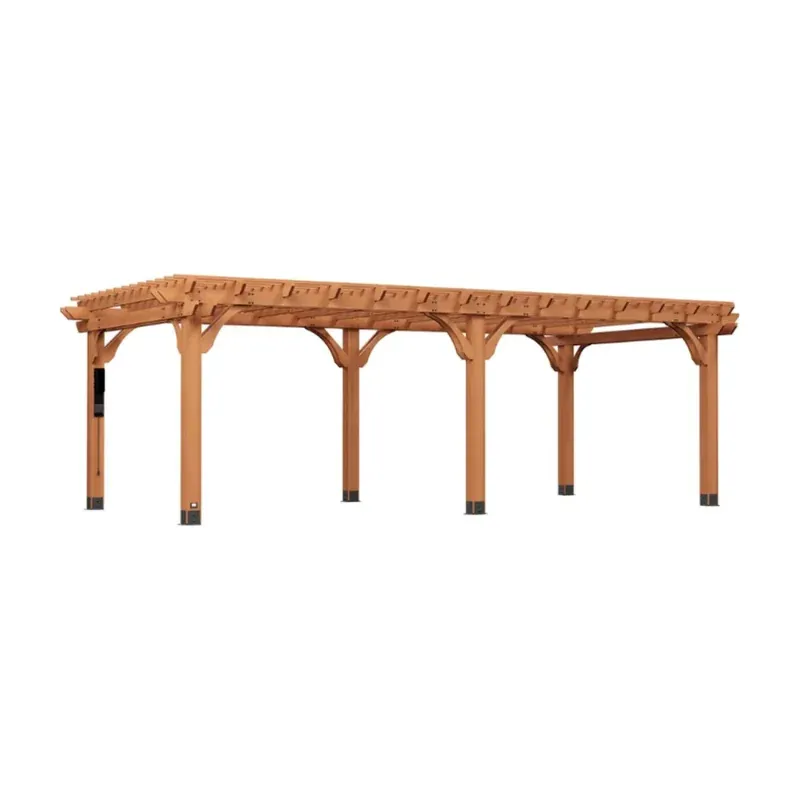
A pergola turns part of a yard or patio into an outdoor room. Unlike a gazebo, a classic pergola does not keep you dry: its roof is an open frame of beams and slats that breaks up the sun and gives climbing plants, lights and fabric somewhere to hang. Newer designs add adjustable louvers that can close against rain. This pergola buying guide covers the choices in order: what you want the pergola to do, where it stands, the roof style, size and headroom, the frame material, ratings and anchoring, and assembly. The examples come from the pergolas we carry, and every figure is taken from the maker’s product page.
Decide what the pergola is for
Write down the job before you look at models. Common answers are dappled shade over a dining table, a frame for string lights and climbing plants, a defined lounge area on a large patio, or a covered space against the house that can be closed when it rains. The first three are what an open pergola does well. The last one points toward a louvered roof, or toward a gazebo; our gazebo buying guide covers that route.
Freestanding or wall-mounted
A freestanding pergola stands on its own posts, usually four, though longer designs use more. It can go anywhere in the yard: over a patio, beside a pool, or at the end of a garden path.
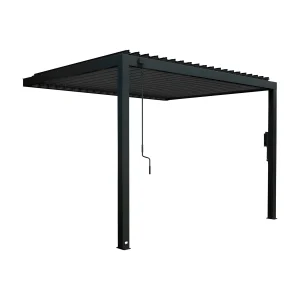
A wall-mounted pergola fixes to a building along one edge and stands on posts along the other. It extends the house outward and needs fewer posts in the way. The Backyard Discovery Evanston 12×10 louvered pergola is built this way: one edge fixes to the wall, posts carry the outer edge, and it covers about 117 sq ft.
Wall mounting raises questions a freestanding pergola does not. The wall has to be able to take the load, the fixings have to suit its material, and water must not be directed toward the house. Have a qualified professional look at the wall before you commit, and check whether your town treats an attached structure differently from a freestanding one.
Roof styles: trellis, purlins and louvers
The roof of a pergola decides how much light gets through and what it looks like from below.
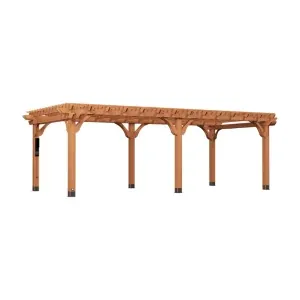
- Open trellis. A grid of beams and slats that filters sunlight. The Beaumont 10×10 uses a trellis built on several levels; the Beaumont 24×12 has an open trellis across its full length.
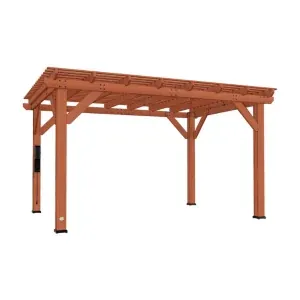
- Wide purlins. Broader boards laid across the beams, which cast wider bands of shade. This is the roof on the Backyard Discovery Delray 14×10.
- Adjustable louvers. Slats that tilt from open to shut. On the Evanston they turn with a hand wand, and water is led away inside the frame and down the posts, out of sight. When closed, a louvered roof sheds rain, which is something an open trellis cannot do.
An open roof can be dressed with a shade sail or climbing plants later, but those additions change how the structure behaves in wind. Check with the maker before adding fabric to a pergola rated without it.
Size, headroom and post spacing
Pergolas range from compact to very long. In our range the Dura-Trel Kingston measures 7 x 7 ft inside the posts, enough to frame a bench or a small bistro table. At the other end, the Backyard Discovery Beaumont 24×12 covers 288 sq ft on six 6 x 6 in posts, enough length to set up two separate areas, such as seating and dining.
Three measurements matter more than the name on the box.
Inside the posts versus overall
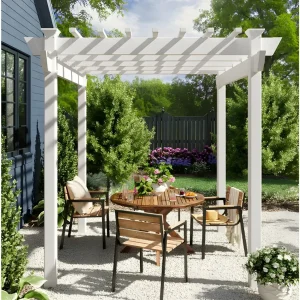
Some makers quote the space between the posts, others the overall size including overhangs. The Kingston’s 7 x 7 ft is the inside measurement. The Evanston is sold as 12 by 10 ft, but its maker states the actual size as 11.75 by 10 ft. Plan furniture against the inside figure.
Headroom
The Beaumont 24×12 has its beam at 7 ft 11 in, with 7 ft 1 in of headroom underneath. The Delray’s beam also sits at 7 ft 11 in. The Evanston reaches 8 ft 5 in overall. If you plan to hang a light, a fan or plants, subtract their drop from the headroom.
Post spacing
On the Beaumont 24×12, the six posts stand 10 ft 3 in apart. Post positions decide where a table and chairs can go and where you walk in, so mark them on the ground before ordering.
Frame materials
Our pergolas use three materials, each with a different kind of ownership.
- Cedar. The Beaumont and Delray models are cedar, supplied pre-cut and pre-drilled with a factory stain. Wood gives the classic look and can be refinished in later years.
- Vinyl. The Kingston is white vinyl, made to resist the weather, and has a clean, bright look.
- Powder-coated steel. The Evanston’s frame is galvanized steel under a black powder coat, which suits the louvered design and its hidden drainage.
Our article on cedar, vinyl and steel pergolas compares what each material asks of you over the years.
Wind and snow ratings
Where makers publish ratings, they are on the product page, along with the conditions behind them.
- Backyard Discovery gives the cedar Beaumont and Delray models a wind rating of up to 100 mph, valid once they are anchored as specified. A snow rating is not published for these open-roof models.
- The Evanston, with its louvered roof, is rated for 100 mph winds and 2,100 lb of snow, which its maker equates to 12 in.
- The Dura-Trel Kingston 7×7 vinyl pergola is rated for 40 mph winds and 150 lb of snow.
The ratings are not directly comparable: each applies to that model, with its own roof area and its own anchoring. Read them as the maker’s design limits for that structure, and anchor exactly as specified, because the rating assumes it.
Anchoring and foundations
Every pergola needs a firm, level base and a way to hold each post down. What comes in the box varies. The Kingston includes ground anchors for lawn and soil, while a deck or concrete slab calls for other hardware that is not in the box. The Beaumont 24×12 uses galvanized steel hardware with steel base plates. On a deck, have whoever built it, or another qualified professional, confirm the framing will hold the pergola and its anchors.
Built-in power
Several Backyard Discovery pergolas include the PowerPort: one post that carries three electrical outlets plus three USB ports. On the Beaumont 24×12 the outlets are listed as 120V. It is a convenient place to plug in string lights or a speaker. How the post connects to your home’s supply is a question for a licensed electrician and your local rules.
Permits and HOA approval
Rules for pergolas vary widely. Some places treat a small freestanding pergola as a garden feature, others treat any permanent structure, and especially one fixed to a house, as something that needs approval. We do not quote rules because they differ from place to place. Ask your building department and your HOA about size, height, setbacks and attachment to the house before you order.
Assembly
All of our pergolas are kits. Putting one up is not a service Moliser offers; our FAQ explains how we help by phone or email while you build. The makers publish some useful planning details:
- The Kingston is designed for two people with everyday household tools.
- Backyard Discovery supplies pre-cut, pre-drilled parts and guides the build through its BILT app.
- The Beaumont 24×12 arrives as four cartons weighing 762.8 lb between them; the Evanston in four cartons totaling 492.52 lb; the Delray in three cartons totaling 396.83 lb.
Assembly times are not published for these models, so we do not estimate them. Carton weights alone tell you to plan for several helpers, a clear staging area and ladders suited to the beam height.
Frequently asked questions
Does a pergola keep the rain off?
An open trellis or purlin roof does not. A louvered roof such as the Evanston’s sheds rain when the louvers are closed. If rain cover is the main goal, compare a louvered pergola with a hardtop gazebo.
What size pergola do I need for a dining table?
Measure your table with the chairs pulled out, add room to walk around it, and compare that with the inside-the-posts size on the product page. Mark the post positions on the ground to see how they fall.
Can I attach a pergola to my house?
Only a design made for it, such as the wall-mounted Evanston, and only to a wall that a qualified professional has confirmed can take the load. Check local rules for attached structures too.
How do I look after a vinyl pergola?
The Kingston is made of white vinyl designed to resist the weather. Its product page does not publish a care routine, so follow the instructions Dura-Trel supplies with the kit.
Does Moliser install pergolas?
No. We sell the kits and help with questions during assembly, but we do not provide installation.