

Anchoring a Pergola: Lawn, Deck and Concrete Options
The short answer
Anchor a pergola to suit its surface: ground anchors or concrete footings in lawn, fixings into the joists or blocking of a deck, and anchors made for concrete bolted through the post plates on a slab. The wind and snow figures makers publish hold only once the posts are fixed down the way their instructions describe.
A pergola’s open roof catches less wind than a solid one, but it still has to stay put when a storm comes through, and its wind figure applies only once it is fixed down the way the maker describes. Anchoring a pergola comes down to two questions: what surface the posts stand on, and what hardware joins them to it. This guide covers lawn, deck and concrete, and what the makers of the pergolas in our range put in the box and leave out.
Why the anchoring carries the rating
Wind pushes on a pergola sideways and, with plants, fabric shades or closed louvers on top, tries to lift it. The posts pass those forces into whatever they are fixed to. A rating such as the 100 mph figure Backyard Discovery gives its cedar pergolas assumes the specified anchoring; without it, the figure says nothing about your installation. The same applies to the Dura-Trel Kingston’s 40 mph wind and 150 lb snow figures.
What comes in the box
| Pergola | Anchoring detail its maker publishes |
|---|---|
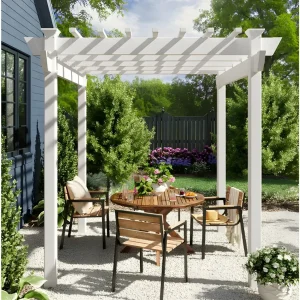
| Kingston 7×7 (vinyl) | Ground anchor kit included for lawns and soil; deck or concrete hardware sold separately |
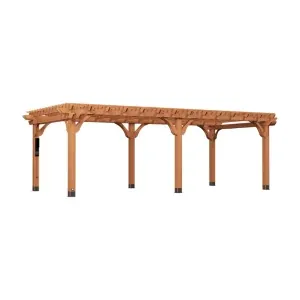
| Beaumont 24×12 (cedar) | Galvanized steel hardware with steel base plates |
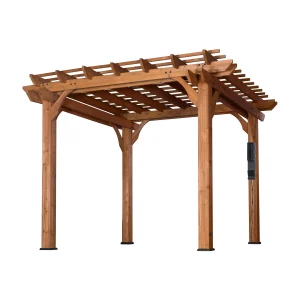
| Beaumont 10×10 (cedar) | Galvanized steel hardware; decorative post covers |
| Delray 14×10 (cedar) | Galvanized steel hardware |
| Evanston 12×10 (steel) | Wall-mounted on one edge; fixings depend on the wall |
The Kingston spells out the split clearly: its ground anchors suit lawn and soil, and fixing it to a deck or a slab needs hardware you buy separately. Where a product page does not say which surface fixings are included, assume you may need to buy anchors suited to your surface, and check the instructions before the day.
Lawn and soil
On grass, anchors are driven or screwed into the ground at each post. Their hold depends on the soil: firm clay holds well, loose sand and waterlogged ground hold less. Before relying on a ground kit:
- Probe the soil at each post position for roots, rocks and buried lines. Have utilities marked before digging.
- Level the footprint; a lawn is rarely as flat as it looks.
- Consider a concrete footing at each post for a heavy timber frame, or where the soil is soft.
Footings also keep a timber post’s base off wet ground, which helps it last.
On a deck
A deck is a structure in its own right, and a pergola fixed to it hands its loads to the deck’s framing. Fix posts into joists or blocking beneath the boards, never into boards alone. Whether the deck can carry a pergola, especially a large one, is a question for whoever built or designed the deck. Bring the pergola’s footprint and post positions to that conversation; for the Beaumont 24×12 that is six posts, 10 ft 3 in apart, on steel base plates.
On concrete
A sound slab is a dependable base. Post plates are bolted down with anchors made for concrete, which usually means drilling with a hammer drill and setting each anchor to the depth its own instructions give. Check before you drill:
- The slab is thick enough at each post position for the anchor you plan to use.
- No crack runs close to a post position.
- Nothing is buried in the slab where you will drill, such as cable or pipe.
- Water drains away from the post bases rather than pooling against them.
Pavers are not a slab. Each block moves independently, so anchoring into one paver gives little hold; set a footing beneath the paver bed at each post instead.
Base plates and post covers
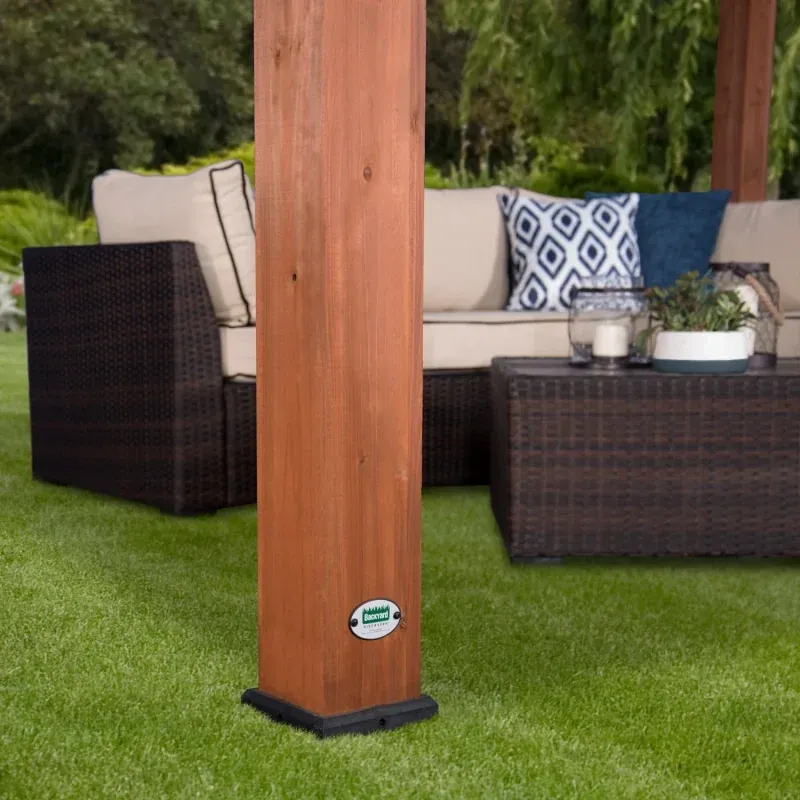
Steel base plates, like those on the Beaumont 24×12, raise the timber slightly and give the anchors a strong place to bite. Decorative post covers, like those on the Beaumont 10×10, finish the base visually. Leave covers off until the anchors are fully tightened and checked, then fit them.
After it is anchored
- Check every anchor and base fixing after the first strong wind, and again each spring.
- Look for soil washing away from lawn anchors, and for cracks around bolts in concrete.
- Re-check if you add a fabric shade, heavy planters or climbing plants, all of which increase the load the frame carries in wind.
Moliser does not install pergolas, and the right fixing for an unusual surface is a decision for a local professional. For the same questions on a gazebo, see our article on gazebo foundations; for the full buying picture, read the pergola buying guide or browse our pergolas.
Frequently asked questions
Does the Kingston include anchors for a deck?
No. Its kit carries ground anchors for lawns and soil; fixing it to a deck or a concrete slab needs hardware bought separately.
Can I anchor into a single paver?
Little hold comes from one block, since each paver moves on its own. Set a footing beneath the paver bed at each post instead.
When should I re-check the anchors?
After the first strong wind, again each spring, and whenever you add a fabric shade, heavy planters or climbing plants that raise the wind load.
When do the decorative post covers go on?
Last. Fit the covers on a frame like the Beaumont 10×10 only after every anchor is fully tightened and checked.