

Gazebo vs Pergola: Shade, Rain Cover and How You Use Them
The short answer
A gazebo has a solid roof that keeps rain off and, on hardtops, carries a snow rating, so cushions and a fan can stay out. A pergola has an open frame that filters sun and lets rain through. If you want both, a louvered pergola opens and closes its roof with a hand wand.
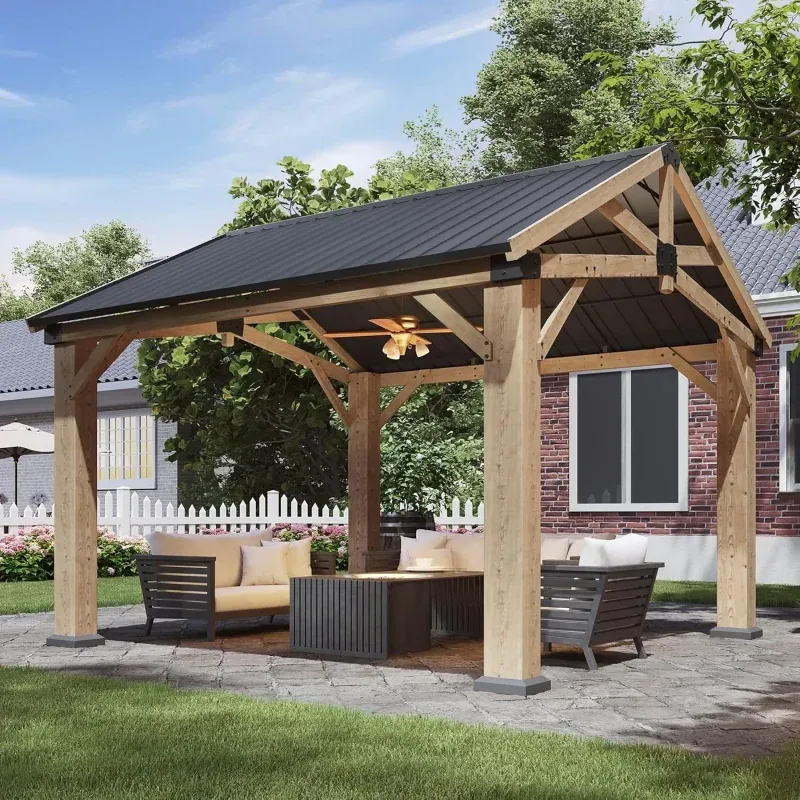
Gazebos and pergolas both put a frame over a patio, and in photos they can look alike. In use they are different tools. A gazebo has a roof meant to keep rain off; a classic pergola has an open frame meant to soften the sun while leaving the sky in view. Some designs sit in between. This gazebo vs pergola comparison looks at shade, rain cover, placement and anchoring, with examples from our gazebos and pergolas, so you can match the structure to how you plan to use the space.
The short answer
- Choose a gazebo if you want to sit outside in light rain, leave cushions or a fan in place, or need a roof that is rated for snow.
- Choose a pergola if you want filtered sun, climbing plants or lights across the beams, and an open feel over a patio, and you are fine bringing cushions in when it rains.
- Look at a louvered pergola if you want both, with the ability to open and close the roof.
Roof and rain
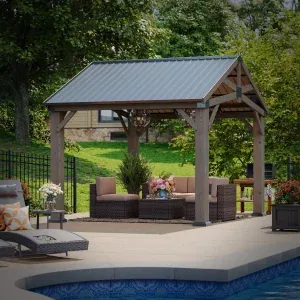
The Aoxun 10×12 pavilion is a clear example of a gazebo roof: a gable metal hardtop described by its maker as waterproof and UV-protective, peaked like a cabin roof. Rain runs off the two slopes. The Arcadia models from Backyard Discovery use a single sloped roof of 29-gauge galvanized steel.
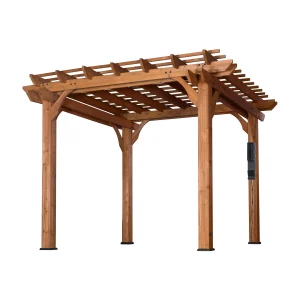
A trellis pergola does the opposite on purpose. The Beaumont 10×10 has a multi-level trellis that filters the sun rather than blocking it, and rain falls through. The Delray 14×10 uses wide purlins that throw broad bands of shade.
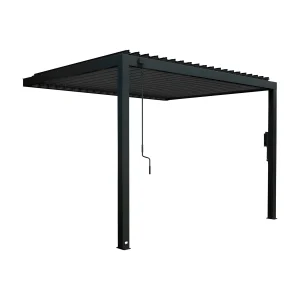
The Evanston 12×10 louvered pergola bridges the two. A hand wand turns its louvers from open to shut, and rain is led into a concealed drainage path through the frame and posts. Closed, it behaves much like a roof; open, it lets light and air through.
Shade through the day
A solid roof gives full shade directly beneath it, and the shaded patch moves across the floor as the sun moves. An open pergola gives a pattern of light and shade that changes through the day; how dense it is depends on the spacing and depth of the slats or purlins and on the angle of the sun. A fabric shade or a climbing plant can fill in the frame. If you need reliable shade at a particular hour, stand on the spot at that hour and note where the sun sits.
Placement: freestanding or against the house
Gazebos are freestanding: four or more posts, a roof on top, and access from every side. That makes them easy to place mid-lawn or where a garden path ends.
Pergolas come both ways. Four of the five pergolas we carry stand on their own posts. The Evanston fixes to the house on one side while posts hold up the other, turning a stretch of wall into a covered patio of about 117 sq ft. A wall mount depends on the wall: its structure, its cladding and where roof water will run. The choice between the two is covered in our wall-mounted vs freestanding pergola guide.
Weather ratings
A hard roof carries whatever snow lands on it, so on a gazebo the snow figure deserves a close look. Here is how a few structures from our range compare:
| Structure | Type | Wind | Snow |
|---|---|---|---|
| Aoxun 10×12 | Gazebo, gable metal roof | 73 mph (expansion bolts fitted) | 15 in of snow |
| Arcadia 12×9.5 | Gazebo, steel roof | Up to 100 mph when anchored | 5,800 lb, about 30 in, when anchored |
| Beaumont 10×10 | Pergola, trellis | To 100 mph, once anchored | Not published |
| Evanston 12×10 | Pergola, louvered | 100 mph | 2,100 lb (12 in) |
| Kingston 7×7 | Pergola, vinyl | 40 mph | 150 lb |
An open trellis lets much of the snow fall through, which may be why the cedar trellis pergolas list a wind figure only. A closed louvered roof holds snow, so its snow figure matters.
Anchoring
Both structures depend on anchoring for their ratings. A gazebo’s solid roof catches more wind, so its anchors carry more uplift; a pergola’s open frame catches less, though plants, fabric shades and closed louvers change that. Whichever you choose, the published figures apply only once the structure is fixed down the way its maker describes.
Power and extras
Several structures in our range have a powered post, the PowerPort, with three outlets plus three USB ports: the Arcadia gazebos and the Beaumont, Delray and Evanston pergolas. A gazebo roof gives you a ceiling to hang from: the Aoxun has a hook under the ridge rated for 44 lb. A pergola’s beams carry string lights well.
Which one to read next
If the roof decided it, the gazebo buying guide covers sizes, frames and assembly. If the open frame won, the pergola buying guide does the same for pergolas.
Frequently asked questions
Does rain come through a pergola?
Through a trellis or purlin roof, yes: the Beaumont and the Delray are open frames. The Evanston is the exception, with louvers that shut and a hidden drainage path through its frame and posts.
Which needs firmer anchoring, a gazebo or a pergola?
Usually the gazebo, because a solid roof catches more wind and puts more uplift on its anchors. Plants, fabric shades and closed louvers raise the load on a pergola too.
Can a pergola attach to my house?
Some can. The Evanston fixes to a wall along one edge and stands on posts at the other, while the other four pergolas we carry are freestanding; the wall itself has to be checked first.
Which of them come with outlets?
The two Arcadia gazebos and the Beaumont, Delray and Evanston pergolas each carry the PowerPort, a post fitted with three outlets plus three USB ports.