

Storage Shed Buying Guide: Size, Siding, Floors and Lean-To Kits
The short answer
Buy a shed from the inside out: list and measure what it must hold, pick a footprint and height with room to grow, choose a gable or lean-to roof for the site, then cedar or engineered siding, check whether the floor is included and the door is wide enough, and prepare a level, drained base.
A shed is bought for what goes inside it, and judged by whether that stuff stays dry, safe and easy to reach years later. Getting there means a few decisions made in the right order: what you will store, how big the shed has to be, its shape and roof, the siding, the floor, doors and windows, the weather it has to face, the base it stands on, and how it goes together. This storage shed buying guide walks through each one with examples from the sheds we carry, quoting only what the makers publish.
Start with what goes inside
Make a list before you look at models. Lawn mower, bikes, wheelbarrow, garden tools on the wall, bags of soil, patio cushions over winter, a workbench, shelves for paint and hardware. Measure the bulky items, especially anything on wheels, and note which ones you need to reach often. That list decides the floor area, the door width and whether you need a bench or windows.
Also be honest about growth. Storage has a way of filling up, and a shed that only just holds today’s list will feel cramped next summer. Our article what size shed do I need turns the list into a footprint, step by step.
Footprint and storage volume
Sheds are sold by a nominal footprint such as 10×7.5 or 12×12 in feet, but floor area is only half the picture. Height adds storage, because shelves and wall hooks use the space above the floor. Some makers publish the volume, which helps compare designs of different shapes:
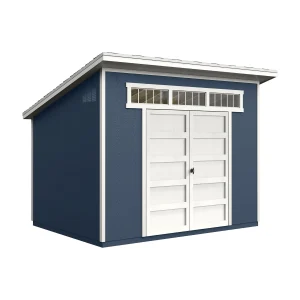
- The Handy Home Olympia 10×7.5 is 10 ft wide, 7.5 ft deep and 8 ft 6.75 in tall, with 565 cu ft of storage.
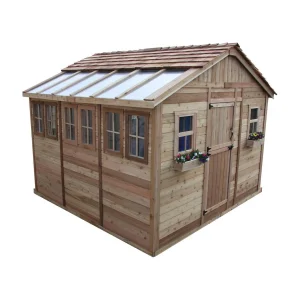
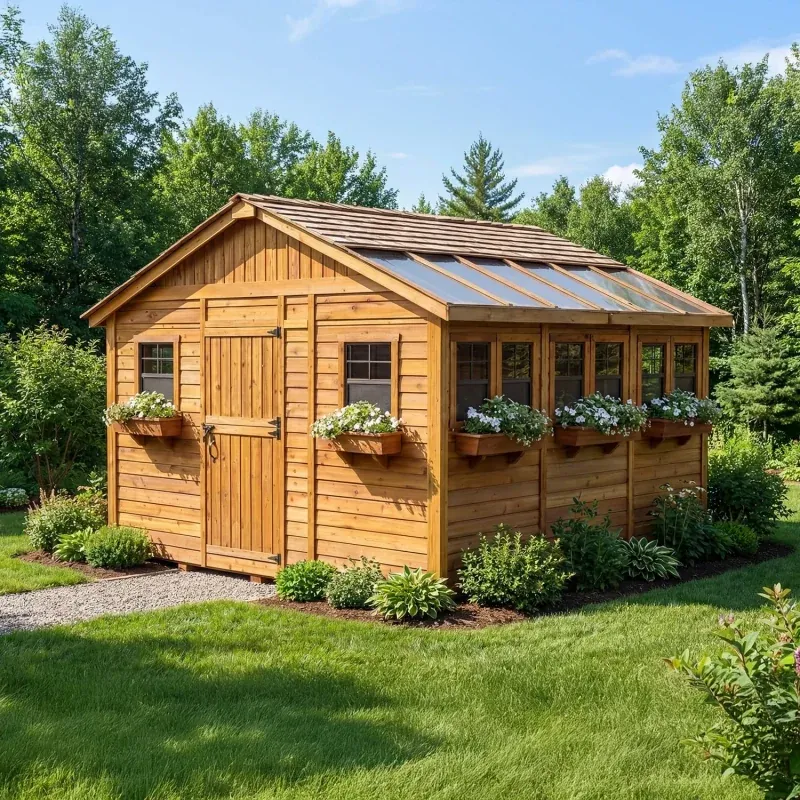
- The Outdoor Living Today Sunshed 12×12 takes up 155 by 145 in on the ground, stands 117 in tall and encloses 838 cu ft.
Where a maker gives both a nominal size and a measured one, plan the ground around the measured figure, and leave room to walk around the shed for assembly and later upkeep.
Shape and roof: lean-to or gable
A gable roof rises to a ridge in the middle, which gives headroom along the center of the shed. A lean-to roof has a single slope, so the shed can sit with its tall side against a fence or a house wall.
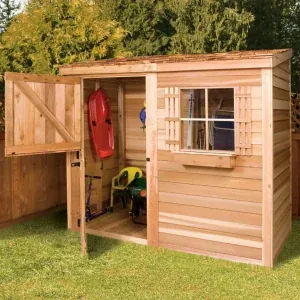
The Cedarshed Bayside 6×3 lean-to shed is designed for exactly that kind of narrow strip. Its single-slope roof arrives as cedar panels already shingled at the factory. If you place a lean-to against a building, plan where the rain from the roof will go, so it runs away from the wall rather than toward it.
Roofs also differ in what they let in. On the Sunshed, one side of the roof is made of twin-wall Polygal light panels, which bring daylight in without any wiring. That is a working shed’s feature, useful if you plan to pot plants or work at a bench.
Siding: cedar or engineered wood
The walls set both the look and the upkeep.
- Western Red Cedar. The Bayside is Western Red Cedar throughout, with walls supplied as panels built at the factory. The Sunshed is clad in Western Red Cedar Architect Knotty siding and arrives without stain, leaving the choice of finish to you. Plan to apply a finish suited to cedar and to renew it over the years.
- LP SmartSide. The Olympia is clad in LP SmartSide, an engineered wood siding. Follow the maker’s guidance on painting and care.
The floor: included or not
Check this line on every product page, because it changes your site preparation.
- The Olympia includes a floor: OSB decking over a treated wood frame.
- The Bayside has a floor of 5/8 in plywood over cedar joists.
- The Sunshed assembles as wall panels on a pre-cut plywood floor.
An included floor still needs a firm, level and well-drained base under it. Where a floor is not included, you need to build or pour one.
Doors, windows and the inside
Doors decide what can go in. The Olympia has lockable double doors, which suit a mower or wheelbarrow. The Bayside and the Sunshed use cedar Dutch doors, split so the upper half can open on its own; the Sunshed’s is 31 in wide. Measure your widest item against the door, not only against the floor.
Windows bring daylight and ventilation. The Olympia has two. The Outdoor Living Today Sunshed 12×12 has ten, framed in aluminum, each screened and lockable, plus an L-shaped workbench 16 in deep along a full wall and seven flower boxes outside. The Bayside has an acrylic window that does not open, with a planter box hung beneath it.
Weather ratings
Handy Home rates the Olympia for wind to 90 mph and snow to 30 lb per sq ft. The Bayside and Sunshed product pages do not publish wind or snow ratings, so we do not quote any. If your area sees heavy snow or strong wind, favor a model whose maker states a rating, and build it exactly as instructed.
Foundations and site preparation
Every shed needs a level, firm base that keeps the floor out of standing water. Common choices include a compacted gravel pad, a concrete slab, or a timber frame on blocks; the right one depends on your soil, your slope and what the maker specifies. Clear the area well beyond the footprint so you have room to work, and check that downspouts and slopes do not send water toward the shed.
Weight is a clue to how solid the base must be. The finished Olympia weighs 1,539 lb before anything goes inside.
Permits and HOA rules
Many towns regulate sheds by their footprint, their height and how close they stand to a boundary, and many HOAs require approval for any outbuilding. Each town sets its own rules, so this guide quotes none. Call your building department and your HOA before you order, and keep the measured dimensions from the product page at hand when you do.
Assembly
Our sheds are kits, and building them is up to you or a contractor you choose; our FAQ explains how we help with questions while you build. The makers publish some details worth planning around. The Bayside’s walls and roof come as factory-built panels, with hardware and instructions included and no cutting needed. Outdoor Living Today publishes an assembly estimate for the Sunshed, shown on its product page. Handy Home does not publish an assembly time for the Olympia, so we do not estimate one. For any shed, plan on at least two people, a level base ready before the cartons arrive, and the tools the instructions list.
When you want a room, not storage
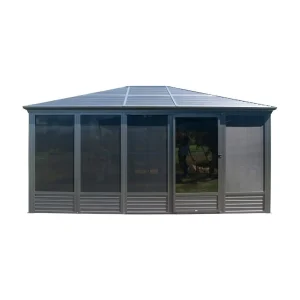
Some buyers who start out looking at sheds really want somewhere to sit. For them there is the Domi Outdoor Living 16.5×13 solarium sunroom, listed with our gazebos. It is a different kind of building: a powder-coated aluminum frame with a galvanized steel roof, fixed Textilene insect screens, PVC panels that fit over them in colder weather and come off again, a lockable sliding door, and more than 219 sq ft of usable floor. If a sheltered room is the goal rather than storage, it belongs on your shortlist.
Frequently asked questions
Does a shed need a floor?
You need something solid and dry to stand on. Some kits include a floor, such as the Olympia’s OSB deck on a treated frame; others need one built. Either way, the floor needs a level, well-drained base.
Can I put a shed against my house or fence?
A lean-to design such as the Bayside is made to sit against a wall or fence. Check local setback rules first, and make sure roof water runs away from the building.
Cedar or LP SmartSide siding?
Cedar gives a natural wood look and needs a suitable finish renewed over time. LP SmartSide is an engineered wood siding; follow Handy Home’s guidance on painting and care.
Do I need a permit for a shed?
It depends on where you live and on the size and height of the shed. Check with your local building office, and with your HOA if you have one, before you order.
Does Moliser assemble sheds?
No. Assembly and installation are not services we provide. The maker’s instructions come in the box, and our team answers questions by phone or email during the build.